
GCSE Learning Routes 2026- 2028
Welcome to our curriculum learning routes information page. The aim of this page is to give you and your child all the information that you need to make informed decisions about the courses and qualifications that you may wish to consider as part of your child’s future curriculum.
Since joining Redhill, pupils have followed the National Curriculum during the Foundation Years. Students have had the opportunity to study a board and balanced curriculum including MFL, Humanities and the Arts. This has given them a wide range of experiences which should help to inform their decision making when thinking about their future curriculum.
Year 10 - Year 11
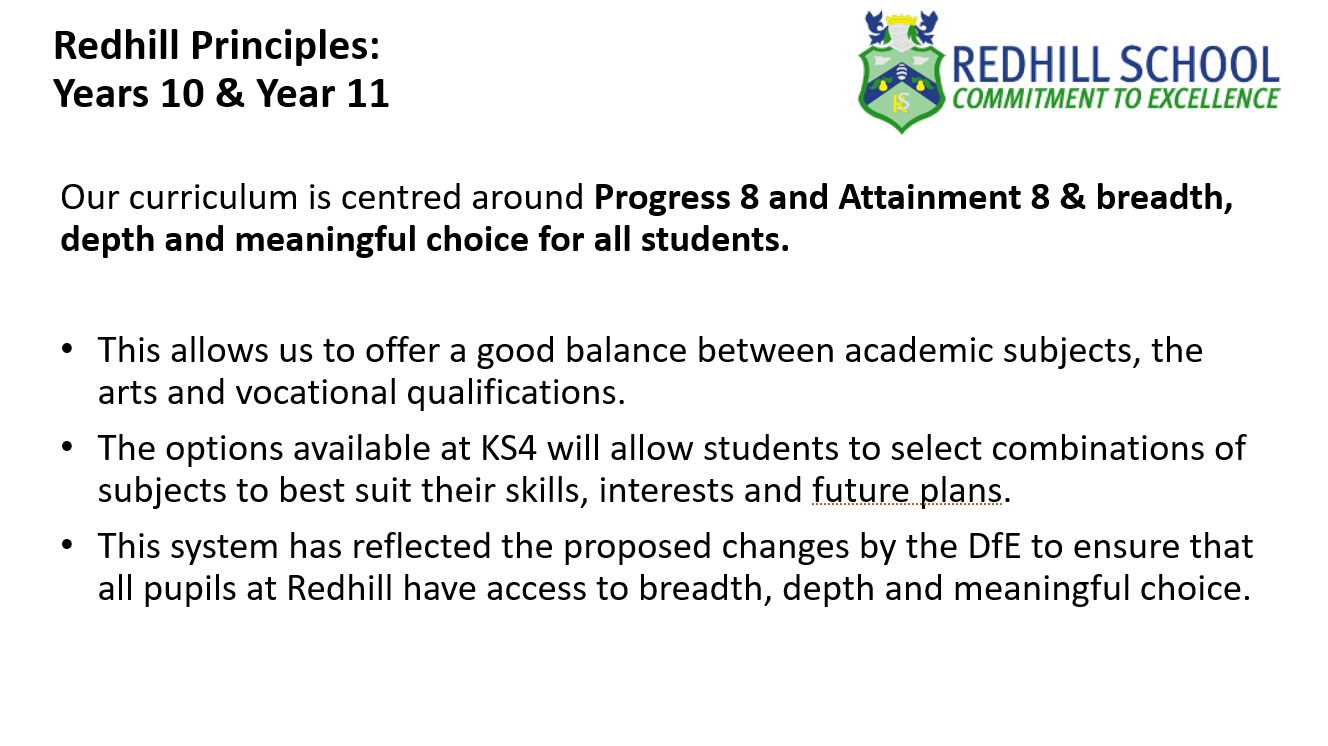
The Learning Routes are based on the latest guidance from the Department for Education (DfE) allowing all pupils at Redhill have access to breadth, depth and meaningful choice.
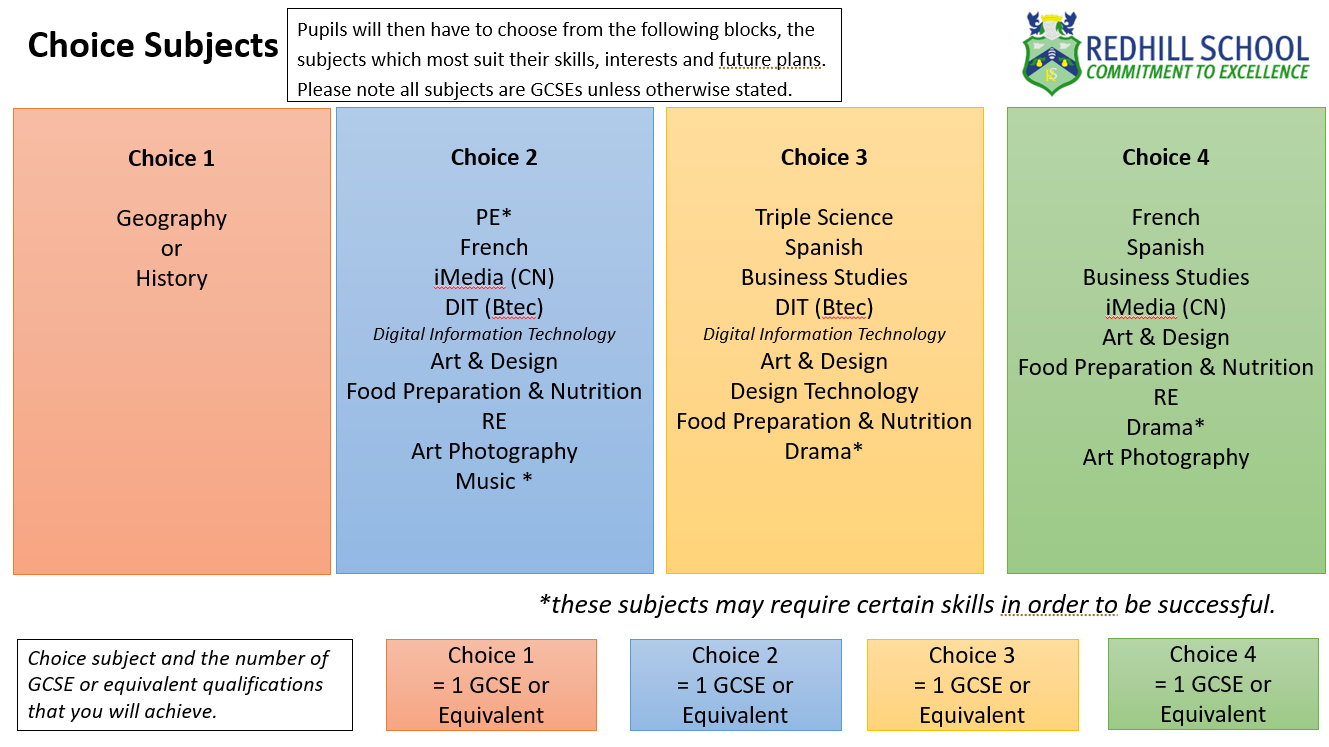
Every pupil follows non-core, GCSE/BTEC/ Cambridge National subjects that we believe develop their strengths and interests.
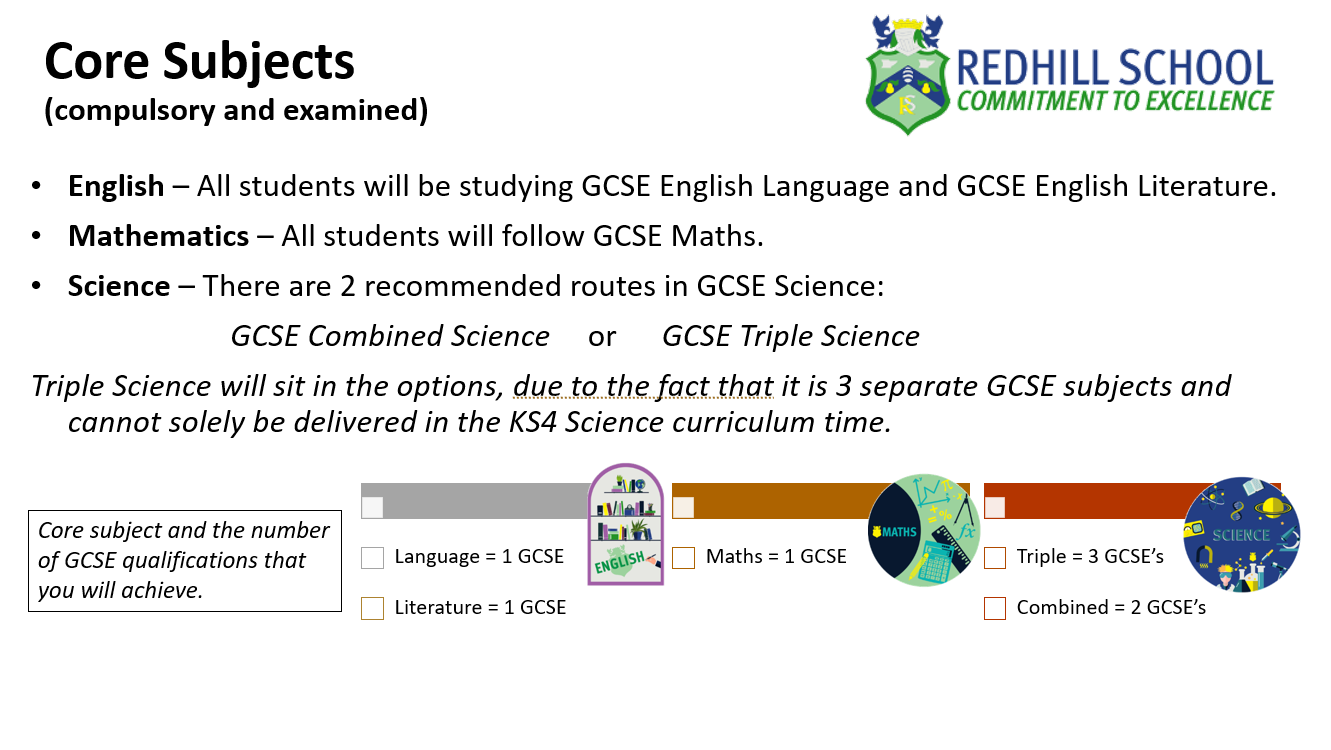
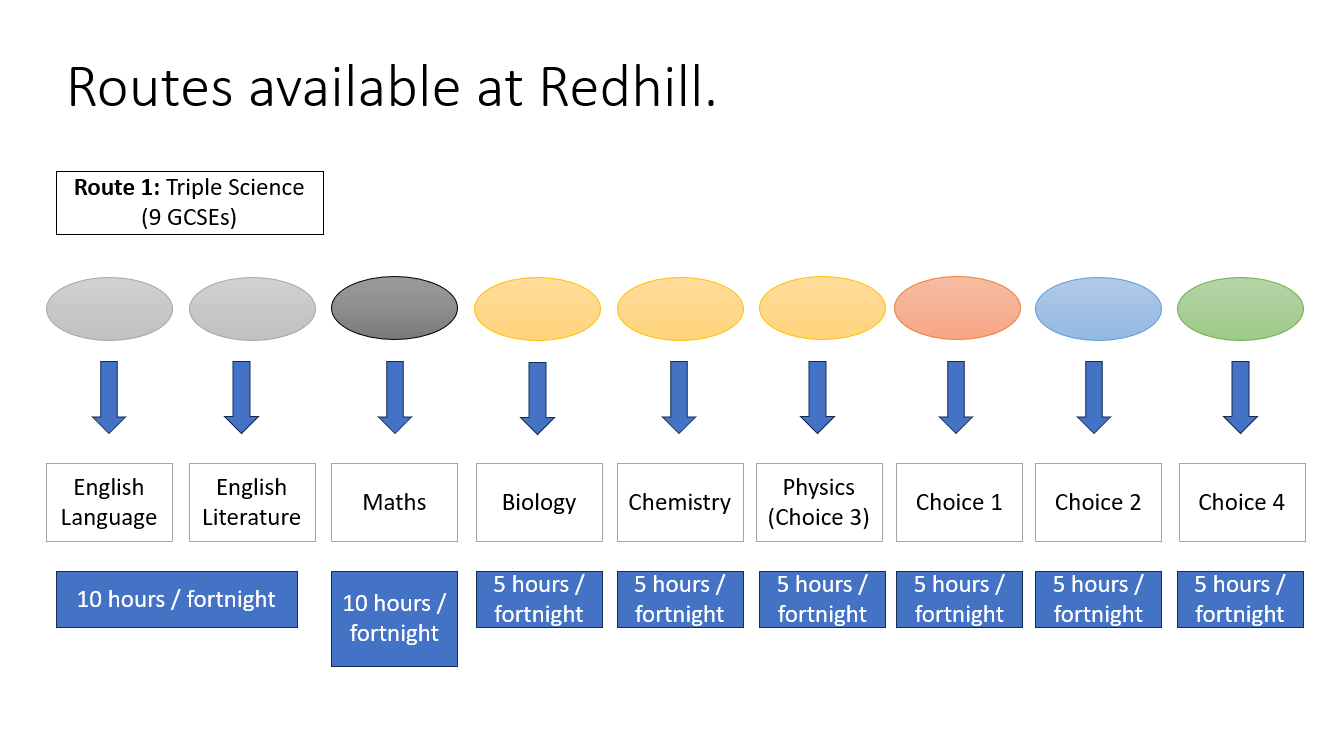
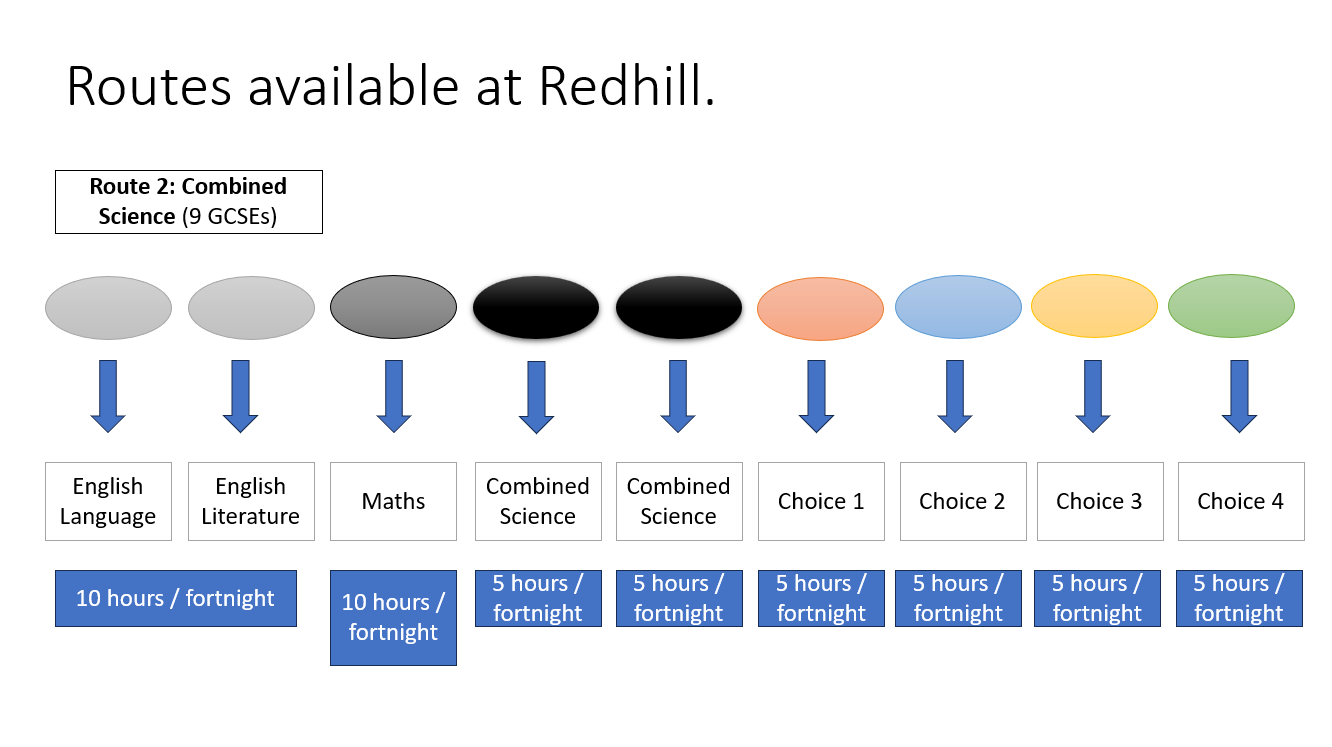
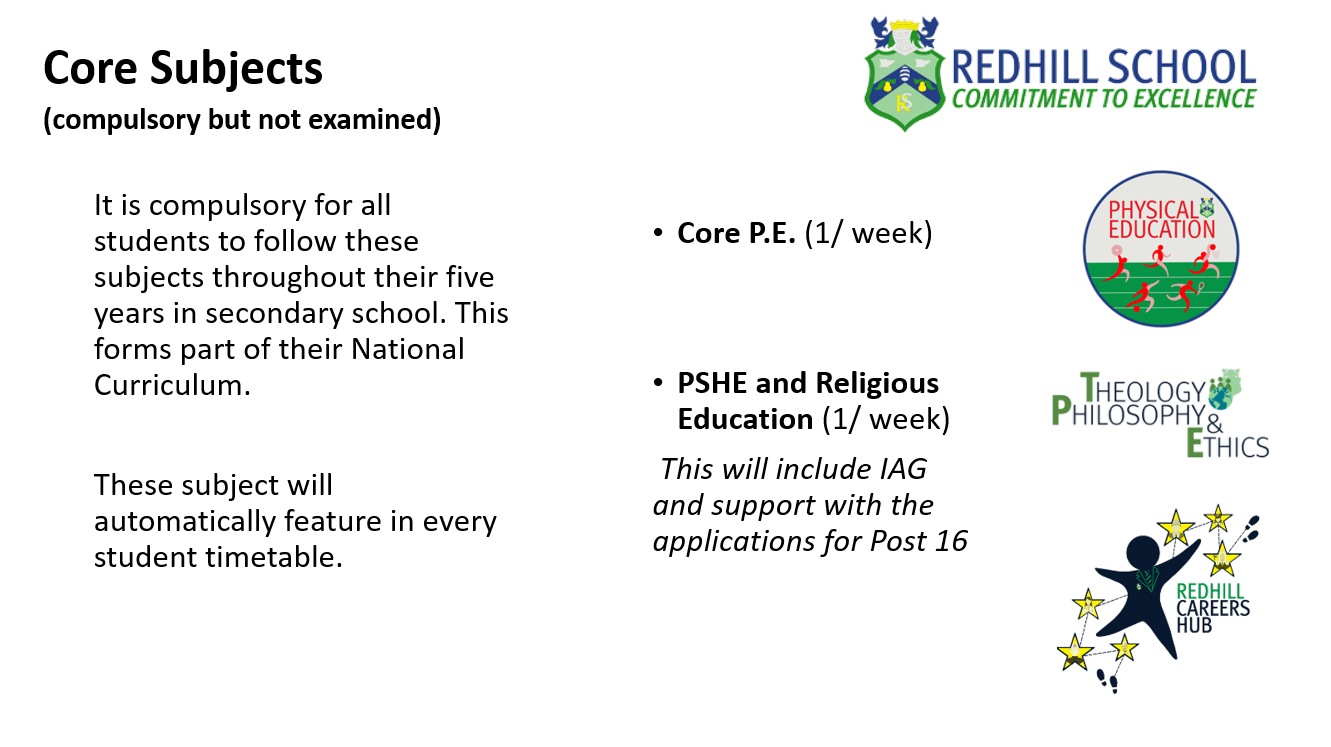
The subjects will be a combination of compulsory core subjects and 3 or 4 choices depending on whether your child decides to follow a triple science or a combined science route.
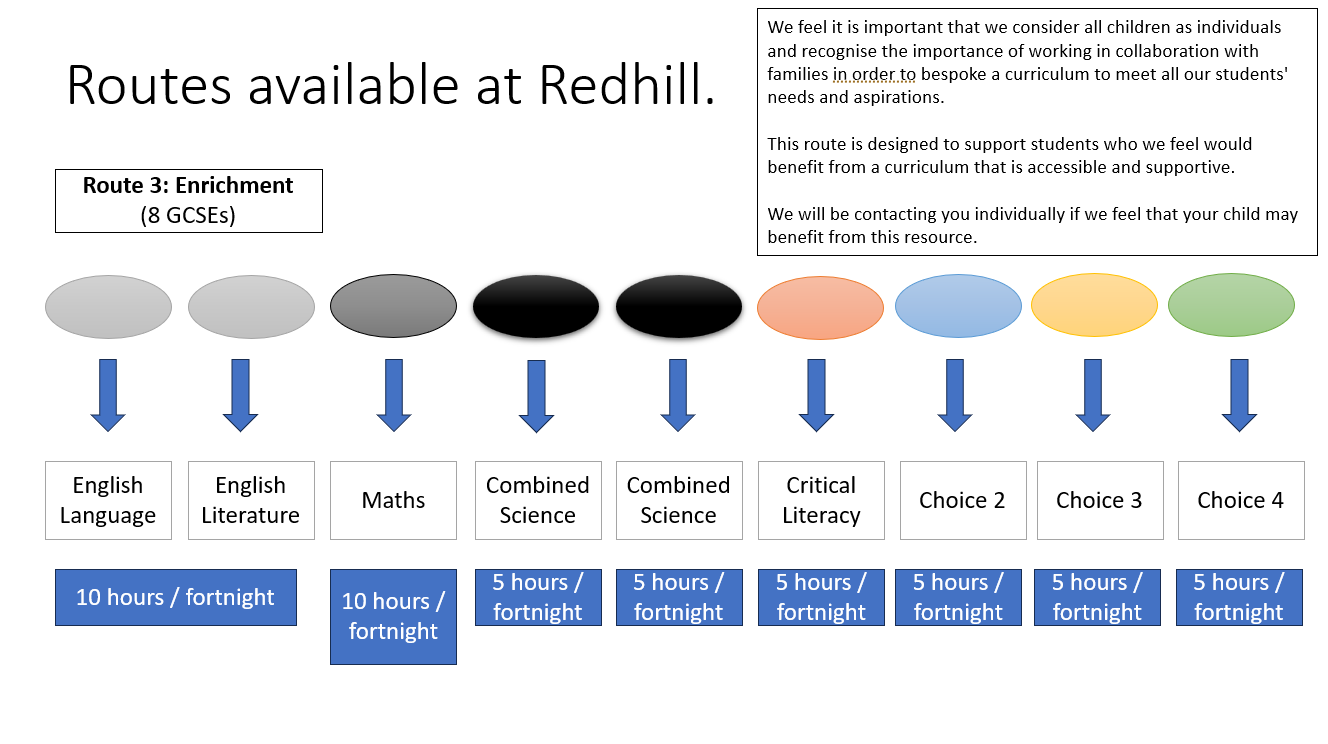
Some students will follow a learning route which will be tailored to meet their individual needs and best support their learning.
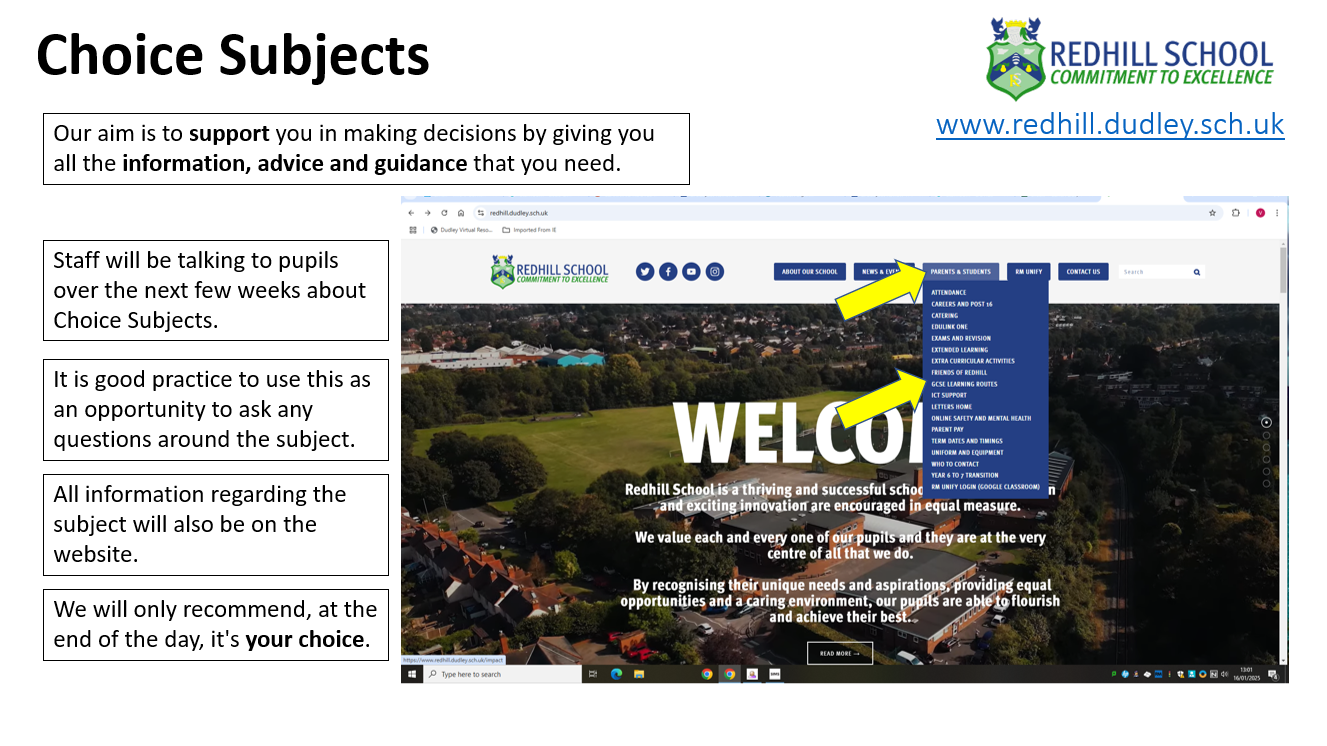
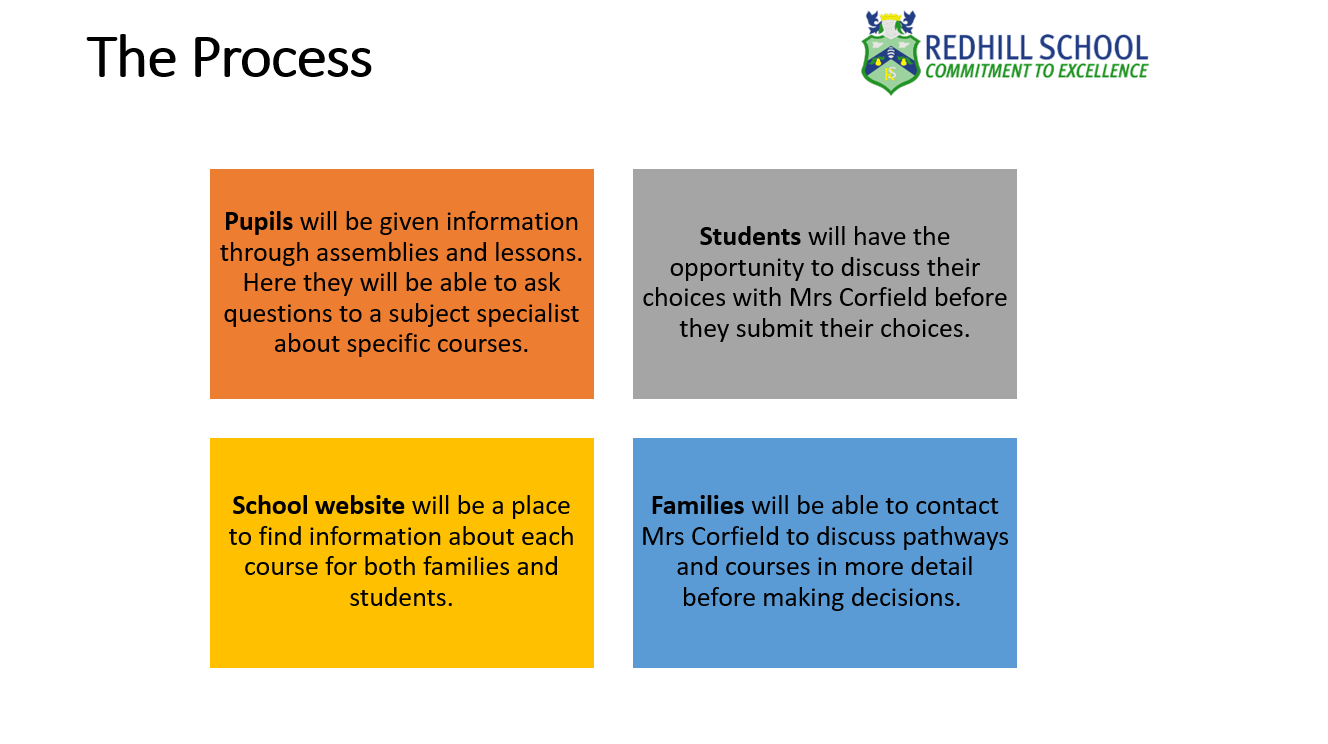
The options process is carefully planned which helps pupils, with support from parents and teachers, to make informed choices about their courses for Key Stage 4.
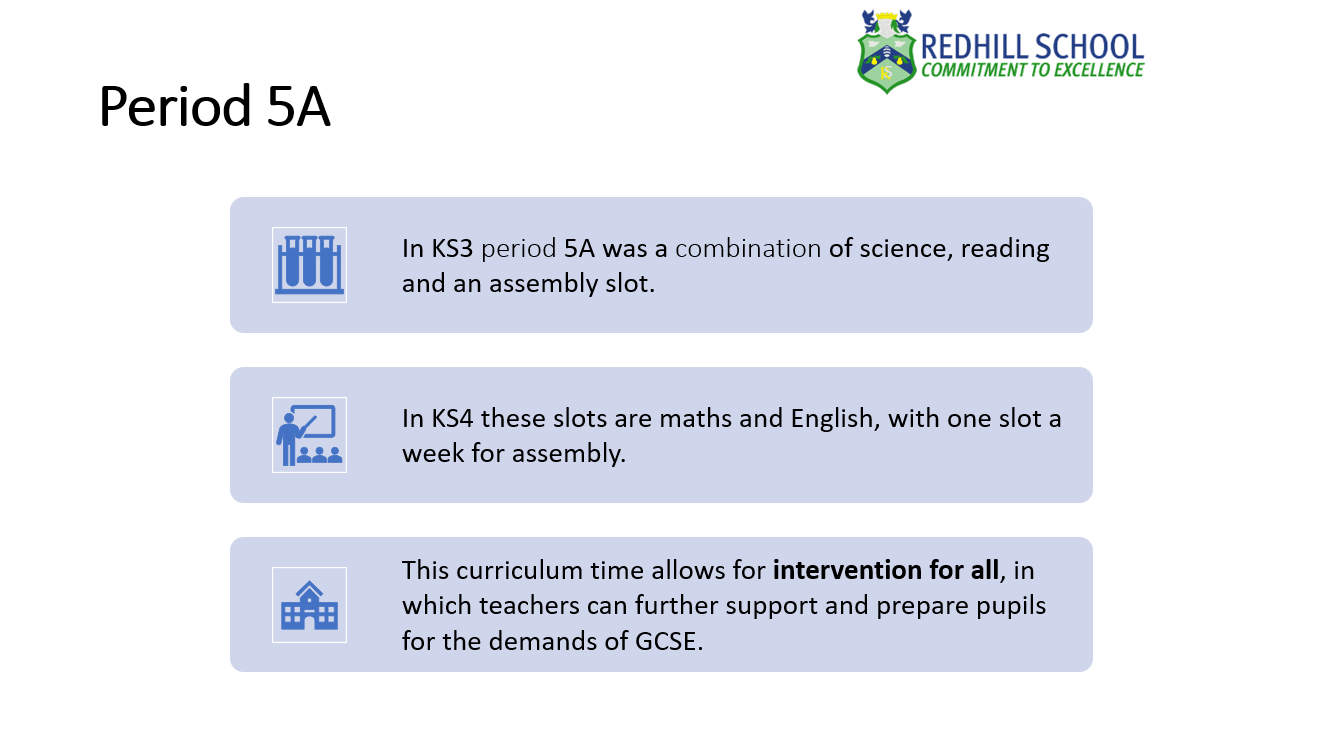
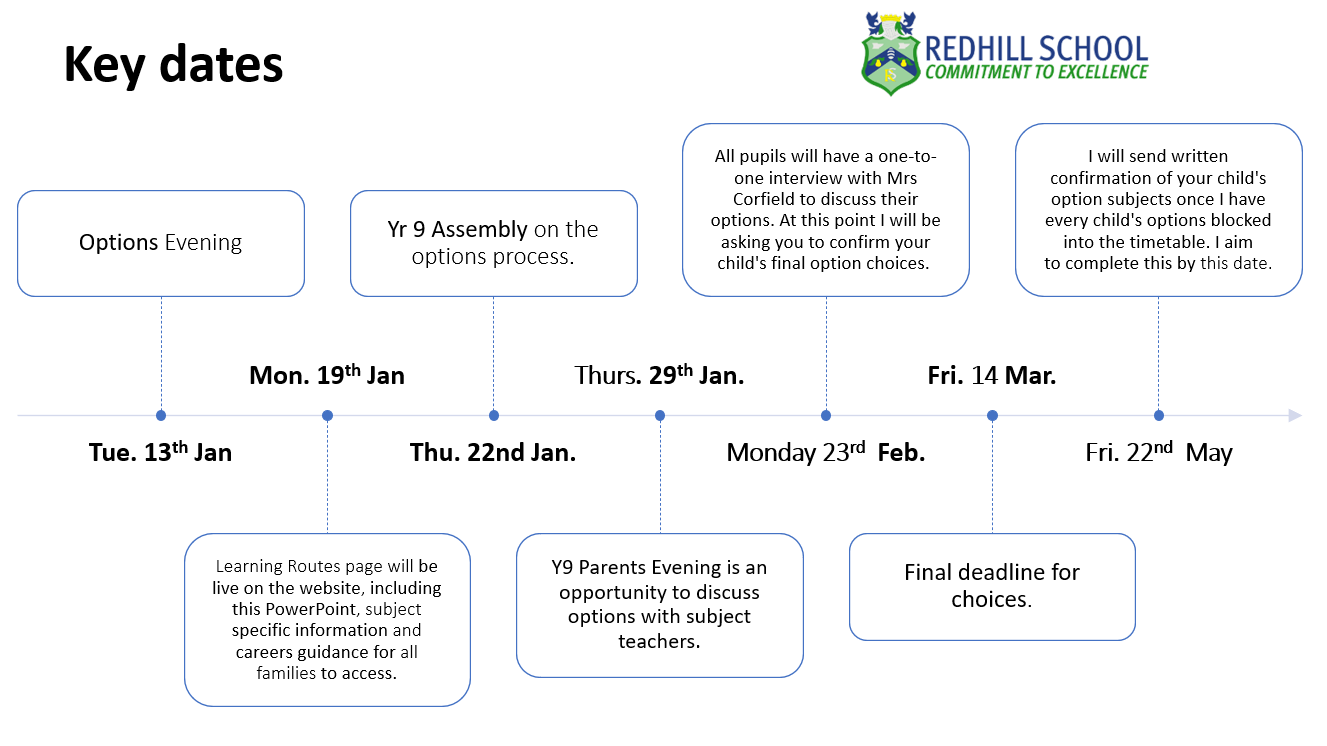
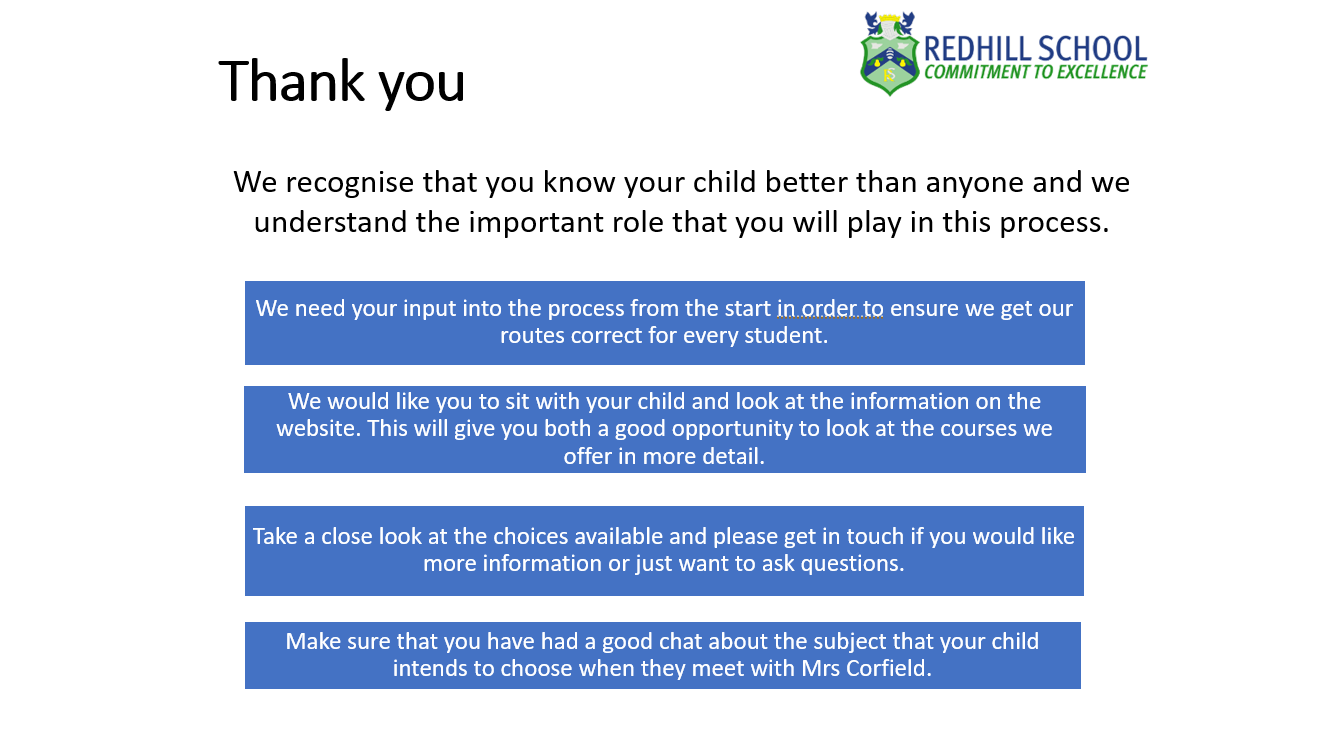
Please find below the presentation, discussed with parents last week. This includes:
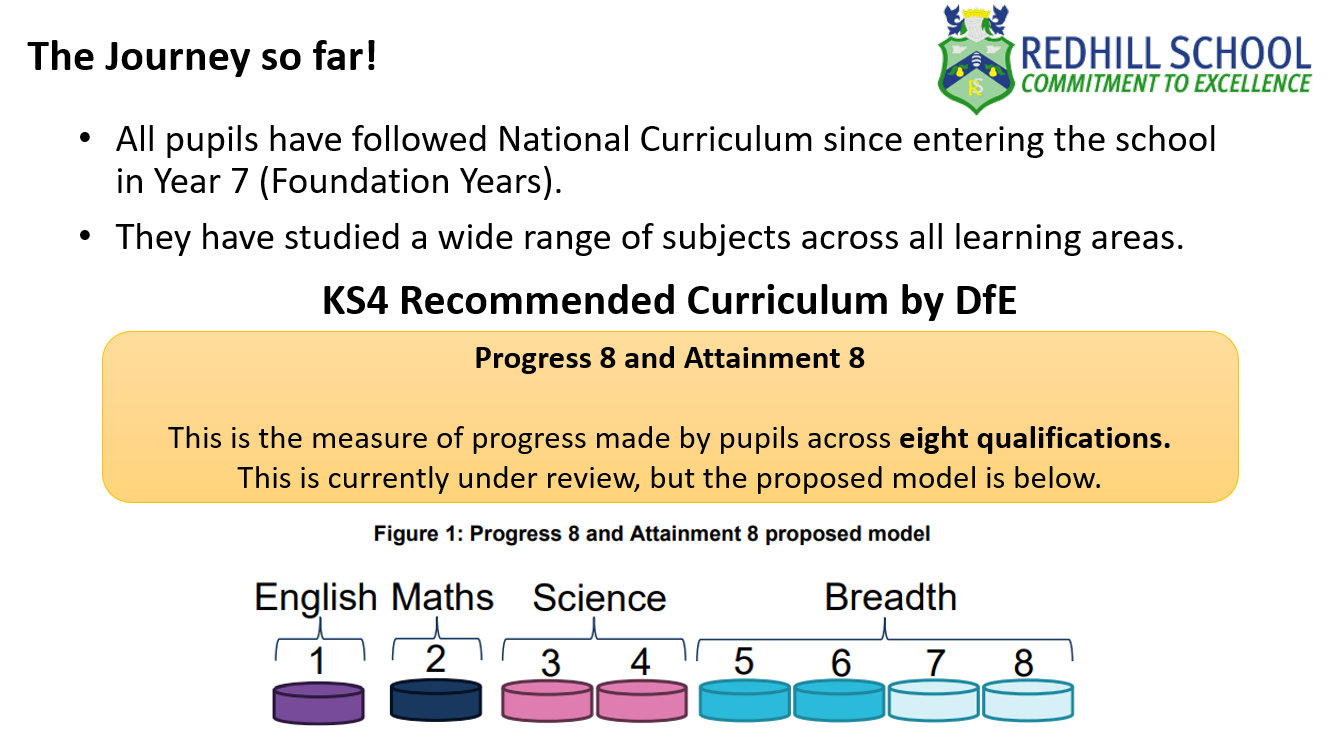
details about how your child’s progress is measured by us and the Department for Education,
details about how to choose options,
a timeline of events/ deadlines.
Recommended Pathway Options Powerpoint
frequently asked questions
Can my child choose History and Geography?
Yes, they can. Please tell Mrs Corfield when you have your 1-2-1 meeting. Please consider though, that by choosing two humanity subjects, this is narrowing your KS4 curriculum slightly, as this will take up one of your choices.
How do I decide whether to choose Triple Science or Combined Science?
Choosing between Triple Science and Combined Science is an important decision, and there are several factors to consider to make an informed choice:
1. Interest and Enjoyment: Reflect on how much you enjoy science and whether you are curious about learning biology, chemistry, and physics in more depth. Triple Science offers a broader and deeper study of each science subject, which can be very rewarding if you have a strong interest in science.
2. Future Aspirations: If you are thinking about pursuing science or STEM-related subjects (like medicine, engineering, or environmental science) at A Level or university, Triple Science is often recommended because it provides a stronger foundation.
3. Workload and Time Commitment: Triple Science involves studying three separate GCSEs, which means more lessons and homework compared to Combined Science, which covers the three sciences but results in two GCSE grades instead of three. Consider your overall workload and how you manage your time.
Traditionally at Redhill the top two sets have followed the Triple Science higher course. We envisage still having these numbers but would also like to have a third group. For timetabling and staffing reasons, we cannot staff more than 3 Triple Science groups because we only have a limited amount of science labs and expert staff.
Do I have to study Triple Science if I am in the top two sets?
No. At the end of the day, it is a choice, and if your child would prefer the combined science route, then they will still be able to make strong progress following that route instead.
Why is it not possible for pupils at Redhill to follow the Triple Science route in the science curriculum time, like with previous cohorts? My child now has one less choice.
This year, we have reduced the Triple Science curriculum time from 12 hours to 10 hours. Subsequently, we have implemented 3 drop down days into the calendar to make up for this learning time. We recognise that this system is not working and is putting further demands on those pupils.
In addition to this, we have to follow the guidance from the Department for Education and offer Triple Science to more pupils, thus making our previous model redundant due to timetabling and staffing complications too.
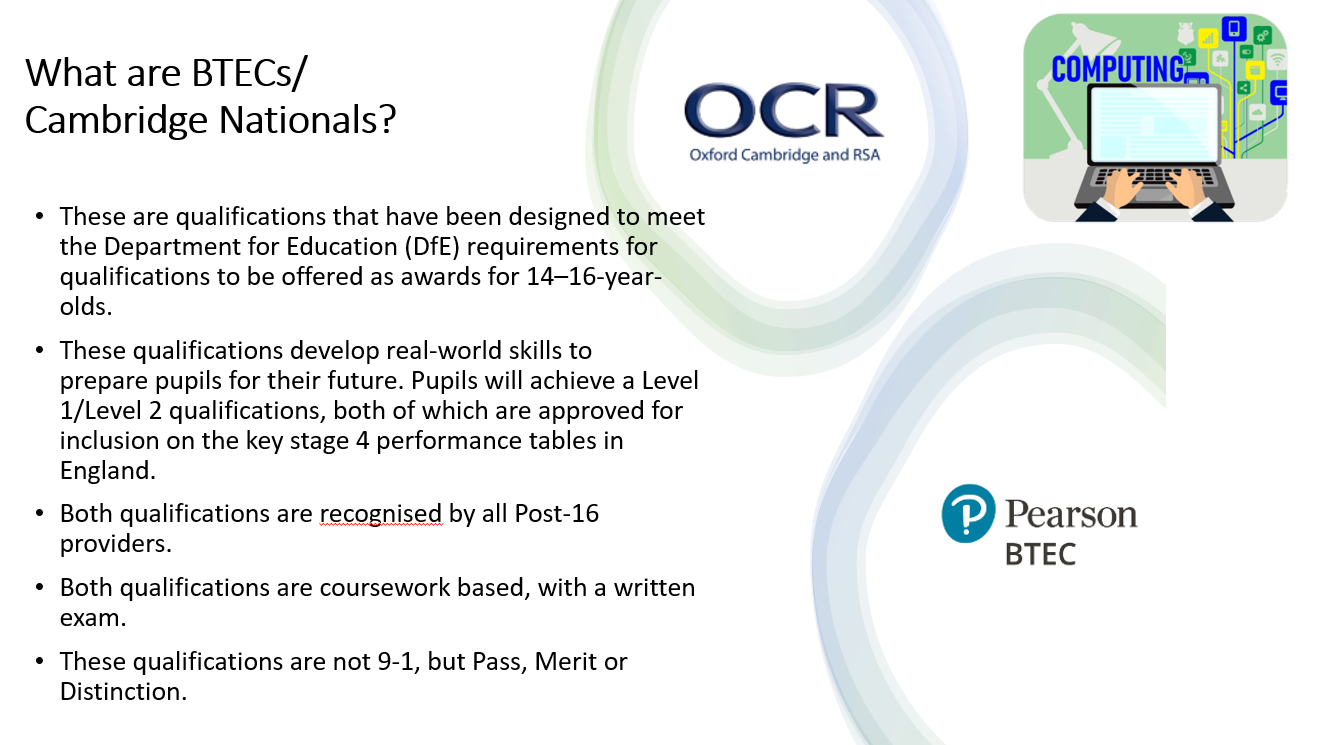
Are BTECs and Cambridge Nationals equivalent to a GCSE?
BTECs and Cambridge Nationals are vocational qualifications designed to provide practical, skills-based learning in specific subjects such as business, health and social care, IT, and engineering.
Both BTECs and Cambridge Nationals are regulated qualifications and are generally offered at Level 1 or Level 2.
GCSEs (General Certificate of Secondary Education) are academic qualifications typically studied in a broader range of subjects and are also Level 2 qualifications.
Equivalence in Level
· Level 2 BTECs and Cambridge Nationals are considered equivalent to GCSEs at grades 9-4 (previously A*-C). This means they are recognised as broadly comparable in terms of the level of study and can be used for progression to further education, training, or employment.
· For example, a Level 2 BTEC First Award or Cambridge National is usually counted as one GCSE qualification.
Differences in Focus
· GCSEs tend to focus more on academic knowledge and theory, assessed mainly by exams.
· BTECs and Cambridge Nationals focus more on coursework, practical skills, and application of knowledge in real-world contexts, often assessed through assignments and projects.
Progression and Recognition
· Both BTECs and Cambridge Nationals are widely recognised by schools, colleges, and employers as valid qualifications.
· They can lead to further education routes such as A Levels, T Levels, apprenticeships, or employment.
· Some more academic university courses may prefer traditional GCSEs in certain subjects, so it’s important to check specific entry requirements if higher education is the goal
Can I choose to do a second language if I have only studied one at KS3?
Potentially. Picking up a language from scratch is difficult, so this decision will be discussed with all stakeholders, as pupils’ aptitude for languages will need to be considered here due to the demands of the GCSE course.
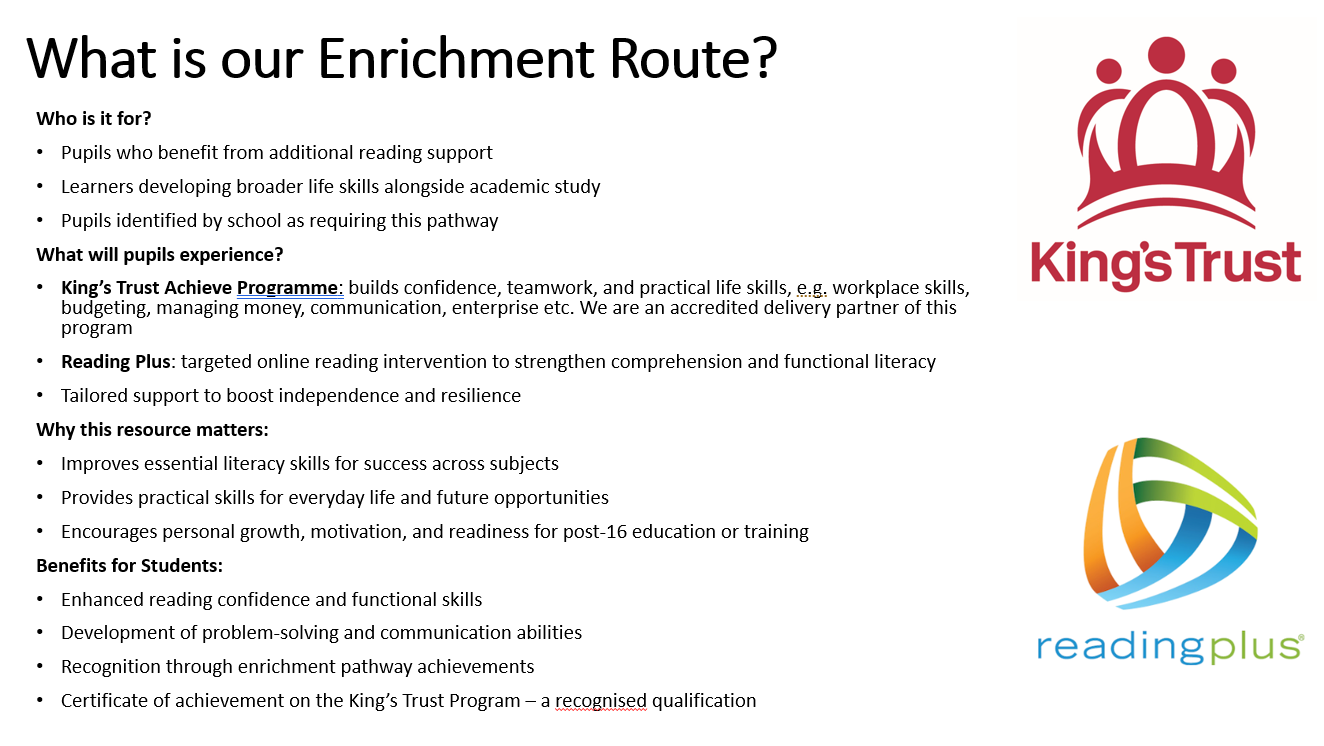
How will I know if my child is suitable for the Enrichment Route?
Mrs Lesniewski (SENDCo) and Mrs Corfield will contact you individually regarding this route.
The Enrichment Route is specially designed for pupils who face significant barriers to learning, particularly those with low reading ages and difficulties accessing the full GCSE curriculum. Here’s how we determine if this pathway is right for your child:
1. Reading Age and Literacy Skills We assess your child’s reading ability using standardised reading tests and diagnostic assessments. Pupils with a low reading age who struggle to decode words fluently and comprehend texts may benefit from the additional reading intervention built into the Enrichment Route.
2. Barriers to Accessing the Curriculum If your child is finding it hard to keep up with the demands of their KS3 curriculum due to literacy challenges or other learning difficulties, the Enrichment Route provides a tailored programme. This includes fewer GCSE choices to reduce pressure and create space for essential support.
3. Support Needs Pupils who need targeted support to improve reading and learning skills, alongside gaining practical qualifications like the Kings Trust qualification, are ideal candidates for this route. This pathway helps build confidence and skills in a supportive environment.
This approach ensures your child receives the right balance of academic challenge and support to help them succeed.
When will I find out which choices my child has?
During the 1-2-1 meeting with Mrs Corfield, your child will be required to give their initial thoughts on routes and choices. There will then be a period of time in which all the data is collected and analysed for timetabling purposes. It may be that you are and your child are contacted during this period if there is a potential issue. It is important to stress that this is a 2-way process and if at any point you have questions or your child would like to ask any questions, please get in touch. The aim is to finalise choices by Easter, but if this is not possible, this will be communicated.
Has a child previously not been able to have their first choices?
We have an excellent record at Redhill of ensuring that most pupils follow the courses they want. Last year, we had 2 pupils who this was not possible for and the previous few years none. Again, this is a 2-way process and if at any point there is a potential issue we will communicate this.
Does my child need to select certain gcses for a particular career path?
Please click this link for more information: https://sites.google.com/redhill.dudley.sch.uk/help-guide?usp=sharing
Core Subjects
Please click on the links below for information about each subject.
Additional Subjects
Please click on the links below for information about each subject.
If you have any questions please contact Mrs V Corfield - pathways@redhill.dudley.sch.uk