
-
-
-
-
-
-
Click here
Assessment, Monitoring and Reporting
Students improve most when they are given clear and prompt feedback on their progress. Our aim is to use our assessment, monitoring and reporting cycle to give student, parents and wider school staff regular information about whether or not a child is “OnTrack” to meet their full potential. Intern if a child should fall below their potential our mission is to understand why and rapidly implement the most effective support possible to get the child back on track.
•Our intention is to use assessment as the process for determining and addressing needs, or “gaps” between a child's current performance and their expected performance at a given point.
•We monitor and analyse data in order to track the progress of children with gaps in their performance.
•We report our findings to all stakeholders in order to identify barriers and implement support and intervention to enable students to close gaps in learning and get back on track quickly.
Understanding Foundation Grades at Redhill School
At Redhill School, we use Foundation Grades (1–9) to track the progress of students in Key Stage 3 across all subjects. These grades help teachers, students, and parents understand how well a child is currently achieving and the progress they are making over time.
It’s important to know that Foundation Grades are not GCSE grades, even though they use the same 1–9 scale. They are an internal measure of progress designed specifically for KS3.
What Foundation Grades Show
A snapshot of current understanding
A Foundation Grade indicates how securely your child is working at the knowledge and skills expected for their year group at this point in time.
Lower numbers show that a student is still developing the core skills.
Higher numbers show growing confidence, understanding, and application of subject knowledge.
Progress over time
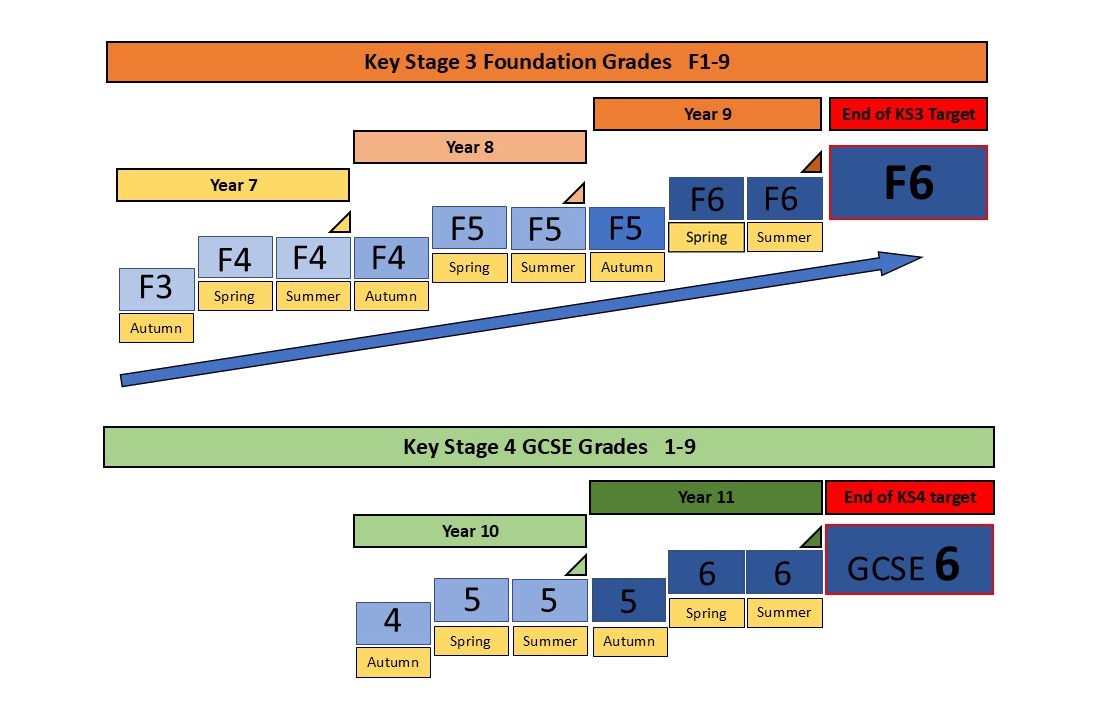
Students move along a flight path between Years 7 and 9. This flight path shows the expected progress for each individual child, based on their FFT20 targets and what we know about students with similar starting points.
Because every child begins KS3 with different levels of prior attainment, each child’s expected progress is unique. That’s why two students may have different Foundation Grades but both still be “on track”.
What Foundation Grades do not mean
They are not predictions of GCSE outcomes.
They do not compare students against each other.
They do not judge ability, but instead reflect current performance and next steps.
Why the numbers vary between children
Parents often ask why one child has a foundation grade of (for example) 4 while another has a 6, even if both seem to be doing well.
This is because:
Students arrive in Year 7 with different starting points.
FFT20 provides each child with an individualised target range.
Their flight path shows the progress they personally are expected to make over time.
So the same Foundation Grade may represent:
Strong progress for one child
Developing progress for another
What matters is whether your child is on their own expected flight path, not how their grade compares to someone else’s.
How teachers use Foundation Grades
Teachers use the grades to:
Identify strengths
Highlight areas needing more practice or challenge
Plan personalised support
Discuss progress during reports, parents’ evenings, and interventions
How “Above”, “On” and “Working Towards” Are Used at Redhill
We know that learning is not linier and that student grades will likely fluctuate each term. Student may be above or working towards on the flightpath at any point. This is simple a snapshot in time and an indication of the current picture. This is not necessarily anything to worry about but may be something to keep an eye on
Alongside the Foundation Grade, you will also see one of the following indicators:
Above Expected
On Track
Working Towards
Helping every child to reach their potential